5 Checks for Taiwan Assets Before a Green Card
Before applying for a U.S. green card, review Taiwan assets for ownership, cost basis, income, reporting, and transfer issues. A change to U.S. tax residency can affect how the IRS views foreign bank accounts, investments, property, insurance, trusts, and gifts. Early review helps you preserve records, identify reporting duties, and avoid preventable compliance problems.
Why should you review Taiwan assets before a green card?
A green card can make you a U.S. tax resident under the substantial presence and residency rules, depending on your circumstances. U.S. tax residency generally means the United States may tax worldwide income, not only income earned in the United States.
That does not automatically mean every Taiwan asset creates tax immediately. The important issue is that an asset may produce income, create an information-reporting obligation, or require records that are difficult to reconstruct later.
The review should cover more than bank balances. It should include assets held personally, jointly, through family members, or through an entity. It should also consider property that does not currently generate cash, such as a family home or inherited land.
For background on the types of people who often face these issues, visit the clients we serve .

What Taiwan assets should you identify first?
Begin with a complete asset inventory. Do not limit the list to accounts that are in your name. Include assets over which you have control, beneficial ownership, signing authority, or a financial interest.
Your inventory may include:
- Taiwan bank, brokerage, and securities accounts
- Real estate, land, rental properties, and property held with relatives
- Life insurance, annuities, pensions, and retirement arrangements
- Shares in private companies, partnerships, or family businesses
- Trusts, inheritances, gifts, and accounts managed for children
For each item, record the owner, account or property location, acquisition date, original cost, current value, income received, and related documents. If ownership is shared, note each person’s role and percentage where available.
This first step is not a tax filing. It is a fact-finding exercise that gives your tax professional enough information to evaluate the next questions.
1. Have you documented the original cost and acquisition history?
Cost basis is the amount generally used to measure gain or loss when an investment or property is sold. For Taiwan assets, the relevant records may be in New Taiwan dollars, while a U.S. tax calculation may require conversion to U.S. dollars under applicable rules.
Gather records showing:
- Purchase contracts and settlement statements
- Bank transfer records and payment history
- Brokerage statements and transaction confirmations
- Inheritance or gift documentation
- Renovation, improvement, and selling expenses for property
Do not assume the current market value is the same as the tax basis. A property that has appreciated may create a taxable gain when sold, while an investment account may contain securities purchased at different times and prices.
Inherited and gifted assets require particular care because the basis may depend on the transfer history and the applicable rules. If records are incomplete, write down what is known and identify what still needs verification rather than estimating without support.
2. Could the assets generate income after U.S. tax residency begins?
Review every type of return from the assets, including interest, dividends, rent, business distributions, pension payments, insurance proceeds, and gains from sales. Taiwan may tax some income under its own rules, but that does not automatically remove a U.S. reporting or tax obligation.
Foreign income may also involve currency conversion. The exchange rate used for income, expenses, basis, and proceeds can affect the U.S. calculation. Keep statements in the original currency and preserve the date and source of any exchange-rate information used.
Rental property deserves separate attention. The review may need to consider rental income, deductible expenses, depreciation, local taxes, repairs, and eventual sale. A property used by family members without rent can raise different questions from a property operated as a rental.
If Taiwan tax was paid on income also reported in the United States, a foreign tax credit may be relevant. Eligibility and calculation depend on the income and facts, so the credit should not be assumed before review.
3. Will foreign account reporting apply?
U.S. tax and U.S. information reporting are related but different. An account may not create taxable income during a period and still require disclosure.
FBAR (Foreign Bank Account Report) is a filing used to report certain foreign financial accounts when the applicable reporting conditions are met. FATCA (Foreign Account Tax Compliance Act) can require additional reporting of specified foreign financial assets on a U.S. tax return.
The analysis may consider:
- Maximum account values during the year
- Whether an account is a bank, brokerage, pension, or other financial account
- Direct ownership, joint ownership, and signature authority
- Accounts held through companies, trusts, or family arrangements
- Whether the account belongs to a spouse or dependent but is reportable through you
Reporting thresholds and filing requirements can change. Some foreign financial products may not fit neatly into familiar U.S. categories. Keep complete annual statements and seek professional review before assuming that a small balance or inactive account is irrelevant.
4. Are gifts, inheritances, or family ownership arrangements involved?
Taiwanese families often manage property and financial accounts collectively. That arrangement may be practical within the family but still require careful classification for U.S. purposes.
Ask whether an asset was received as a gift, inherited, placed in a trust, transferred to a child, or held in another person’s name for convenience. The legal owner, beneficial owner, and person who controls an account may not be the same.
A transfer before becoming a U.S. tax resident may have different consequences from a transfer after residency begins. Timing alone does not answer the question, but it is an important fact to document.
Keep:
- Gift agreements and inheritance documents
- Probate or estate records
- Trust deeds and amendments
- Family ownership agreements
- Evidence of who contributed funds and who receives benefits
Do not move assets between relatives simply to make the records appear simpler. A transfer can create its own tax, reporting, valuation, or documentation issues.
5. Have you checked insurance, pensions, trusts, and investment products?
Some Taiwan financial products do not operate like comparable U.S. products. A foreign life insurance policy, pension, annuity, fund, or savings product may be classified differently under U.S. rules.
Investment funds may involve PFIC (Passive Foreign Investment Company) rules. These rules can apply to certain foreign corporations or pooled investments and may create complex reporting and tax calculations. A product described as a mutual fund or savings plan locally should not be classified by name alone.
Collect the product prospectus, policy terms, annual statements, contribution history, surrender value, beneficiary information, and tax documents. If the provider does not issue a U.S.-style statement, that does not necessarily mean the product is outside U.S. reporting.
Before selling, surrendering, or transferring a product, ask how the action could affect basis, income recognition, reporting, and foreign tax credits. A pre-transaction review is usually more useful than trying to reconstruct the result afterward.
A practical preparation checklist
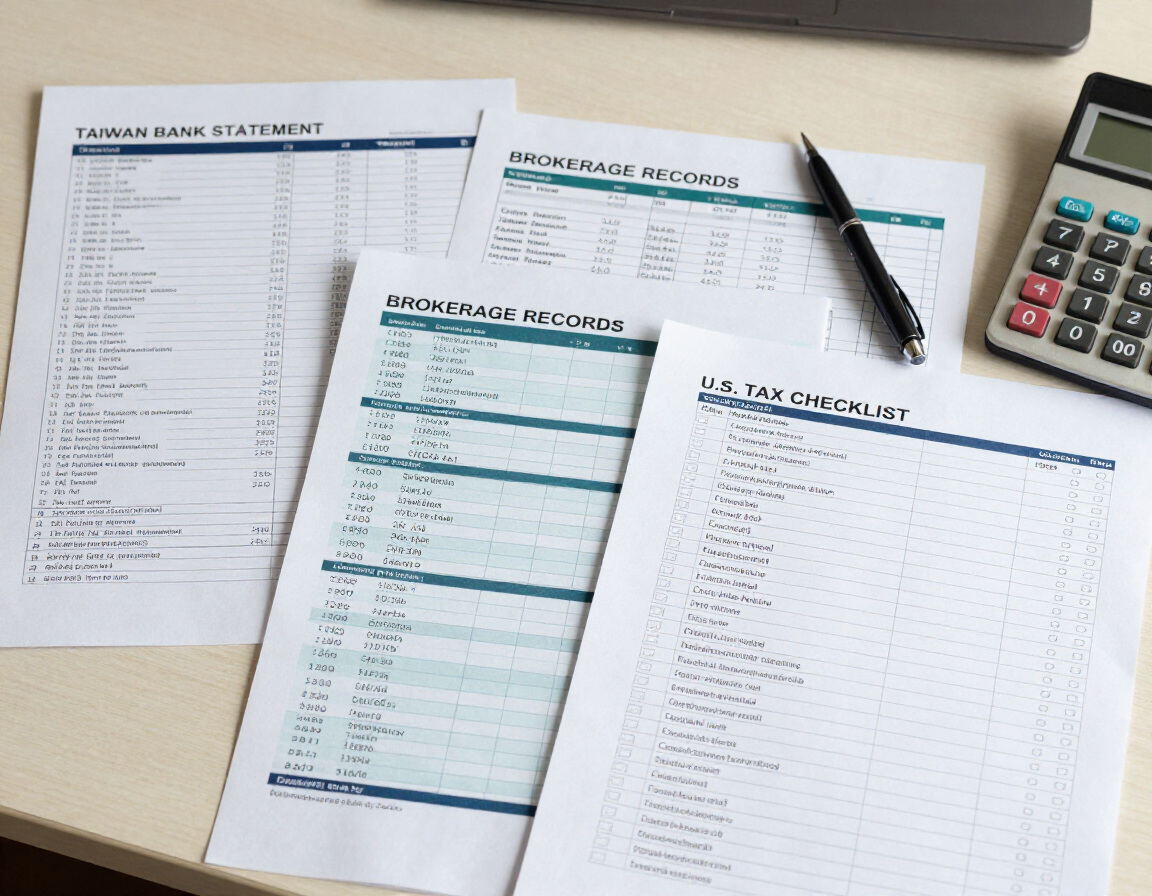
Before speaking with a tax professional, organize:
- A complete list of Taiwan assets and account owners
- Statements covering the relevant years
- Purchase, gift, inheritance, and transfer records
- Income, expense, and foreign-tax information
- Questions about planned sales, transfers, or account closures
Separate confirmed facts from assumptions. For example, note when an account was opened, but do not guess its classification if the product documents are unavailable.
You can also review our tax knowledge resources and common service questions before scheduling a consultation.
What should you do before applying for a green card?
Start the review before the status change or application deadline creates pressure. Gather records, identify missing information, and ask how the timing of residency may affect future income, sales, transfers, and reporting.
A consultation is especially appropriate when you have foreign investment funds, rental property, family-held assets, trusts, inherited property, or incomplete historical records. The purpose is not to assume a tax result, but to understand which facts matter and what documentation is needed.
Key takeaways
- A green card can change the U.S. tax analysis of worldwide income and foreign assets.
- Taiwan bank accounts are only one part of the review; property, insurance, pensions, investments, and family arrangements also matter.
- FBAR, FATCA, and PFIC are reporting or classification issues that should be evaluated separately from income tax.
- Cost basis, ownership, transfer history, and currency records should be preserved early.
- Before acting on a sale, gift, transfer, or account closure, arrange professional advice based on your facts.
Your situation may depend on immigration timing, tax residency, ownership, asset type, and prior filings. This article provides general information, not individual tax advice. For a review of your Taiwan assets before a green card, please contact TripleWinWin to schedule a consultation.
Recent Posts